
The Five Areas of Montessori Curriculum: What Your Child Is Building Every Day in {{City, State}}
Quick Answer
Montessori curriculum is a carefully structured, child-centered approach to learning that covers language, math, practical life, sensorial exploration, and cultural studies. Each area builds on the last, and children move through materials at their own pace with guidance from a trained teacher. In a strong program, the classroom itself is the curriculum. Every material on the shelf has a purpose, and every child has room to grow within it. If you have been searching for a Montessori school in [City], [State], knowing what the curriculum actually looks like can help you ask better questions and feel more confident in your choice.
A curriculum built around how children actually learn
If you have been searching for a Montessori program in [City], [State] and found yourself wondering what the curriculum actually looks like day to day, you are in good company. Most parents come in knowing Montessori has something to do with independence and child-led learning. But what does that mean for your child’s actual education? What are they learning, and how? If you have been searching for Montessori programs in [City] this is the guide for you.
The curriculum is in the room itself
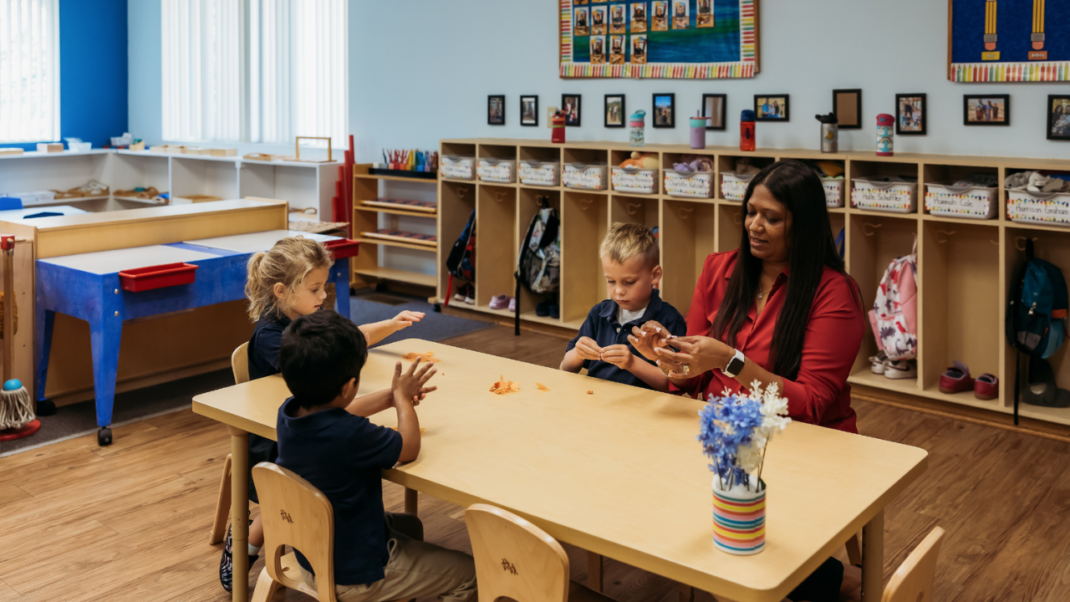
Walk into a Montessori classroom in [City], [State], and the first thing you’ll notice is the shelves. Everything is organized, beautiful, and within reach. That is intentional. In Montessori, the prepared environment is a living part of the curriculum. Materials are arranged by area: practical life, sensorial, language, mathematics, and cultural studies. Children choose their work within a structured block of time. It is purposeful, child-led exploration within a carefully designed framework. And once you see it in action, it is genuinely exciting.
The American Montessori Society’s accreditation standards describe what a high-quality Montessori program is expected to provide, and curriculum integrity is central to it. Schools that earn AMS accreditation are held to clear expectations around the classroom environment, teacher training, materials, and the developmental appropriateness of the work being offered. It is one of the most meaningful signals you can look for when evaluating a program.
What children are actually learning
Here is what the curriculum covers at the preschool level:
- Practical life: buttoning, pouring, sorting, caring for the environment. These activities build concentration, coordination, and independence.
- Sensorial: activities that sharpen the senses and prepare the brain for later abstract learning.
- Language: letter sounds, phonics, vocabulary, early writing, storytelling.
- Mathematics: hands-on materials that make quantities, place value, and operations concrete before they become abstract.
- Cultural studies: geography, science, music, and art woven through the day.
Each area is connected. The fine motor skills built in practical life show up in your child’s ability to hold a pencil. The pattern recognition from sensorial work supports early math. It is a whole-child approach, and it is more cohesive than it might look from the outside.
How teachers guide the work
A Montessori teacher, called a Guide, does not stand at the front of the room delivering lessons. They observe. They move through the classroom giving individual or small-group presentations, introducing new materials when a child is ready. It looks quiet. The classroom operates with a distinct, respectful quiet—an orderly environment where children are deeply immersed in their chosen tasks. Underneath this visible calm, cognitive development is taking place.
Your child is building executive function skills: focus, self-regulation, task completion, through the work they choose. They are learning to manage their time, to return materials to their place, to help a younger child when they are able. The curriculum is preparing children for how to be in the world, not just what to know.
Frequently Asked Questions About Montessori Curriculum in [City]
Is Montessori curriculum structured or just free choice?
It is both, and that is the beauty of it. Children choose their work within a carefully structured environment designed by a trained teacher. There are clear curriculum areas and developmental progressions. Children move through them at their own pace, with a Guide supporting each step. It is a very intentional kind of freedom.
What subjects does Montessori curriculum cover?
A full Montessori curriculum includes practical life, sensorial exploration, language, mathematics, and cultural studies (geography, science, art, and music). These areas are interconnected, and the skills built in one area support growth in the others. At the preschool level, the work is hands-on and concrete, building a foundation for more abstract thinking later.
How do I know if a school is using real Montessori curriculum?
Accreditation is a strong signal. The American Montessori Society has clear standards for what a genuine Montessori program should provide, including trained teachers, authentic materials, and a prepared environment. When you visit, look for those classic materials on the shelves, observe how the teacher interacts with children, and ask about teacher credentials. A school that is doing it right will welcome those questions.
Ready to See the Curriculum for Yourself?
Families in [City] trust [School Name] to preserve the integrity of the Montessori tradition. Here, your child will find a peaceful, prepared environment and dedicated, trained Guides to support their natural journey toward independence. We invite you to schedule a tour to observe our calm classrooms in practice.
Related Posts
All Posts
Inside [City, State]’s Top Montessori Classrooms: What High-Quality Montessori Really Looks Like

Montessori in {{City, State}}: How to Choose an Authentic Montessori Program for Your Child at {{SchoolName}}