
Inside [City, State]’s Top Montessori Classrooms: What High-Quality Montessori Really Looks Like
Quick Answer
Authentic Montessori classrooms are built around five pillars: trained teachers, mixed-age groupings, purposeful Montessori materials, child-directed work choices, and a 2 to 3 hour uninterrupted work cycle. The environment should feel calm, ordered, and set up for children to move and choose independently. Accreditation from AMS or AMI is a strong quality signal, but teacher training, staff stability, and the feel of the classroom tell you just as much.
Not All Montessori Schools Are the Same
If you have been researching Montessori schools in [City], you have probably noticed that a lot of programs use the word Montessori but do not all look the same. That is because Montessori is not a trademarked method. Any school can use the name, which makes it harder for families like yours to know what to actually look for.
This guide breaks down what genuine Montessori looks like in practice, so you can walk into any tour with confidence and know exactly what questions to ask.
What Makes a Montessori Program Genuinely Montessori
Montessori is a rich philosophy with clear, well-documented principles at its core, and the strongest programs make those principles visible every single day. The American Montessori Society (AMS) and the Association Montessori Internationale (AMI) are the two organizations that set and uphold those standards globally. Seeking accreditation from either is a meaningful commitment, and a strong signal that a school takes the approach seriously.
The Five Core Elements of Authentic Montessori
The AMS highlights five key elements that foster a purposeful Montessori Preschool experience. Here is how these principles support your child’s daily discovery.
1. Teachers Trained in the Montessori Approach, Called Guides
At the heart of early childhood education in a Montessori setting is the Guide. Our Montessori-trained teachers observe and support your child’s unique way of learning, acting as a bridge between the child and the prepared environment. That approach requires specific preparation in child development and Montessori methodology. Credentials from AMS, AMI, or MACTE-approved programs are strong signals of that preparation, and ongoing professional development matters just as much as initial training.
During a tour, it is completely appropriate to ask: What does your team’s Montessori training look like, and how do you support teachers in continuing to grow?
2. Multi-Age Classrooms Spanning Three Years
Montessori classrooms intentionally group children across a three-year span, typically ages 3 through 6 in the early childhood room. Younger children learn by watching older peers. Older children reinforce their own understanding by helping younger ones. It builds community, patience, and confidence in ways that same-age groupings often cannot.
3. Specific Montessori Materials
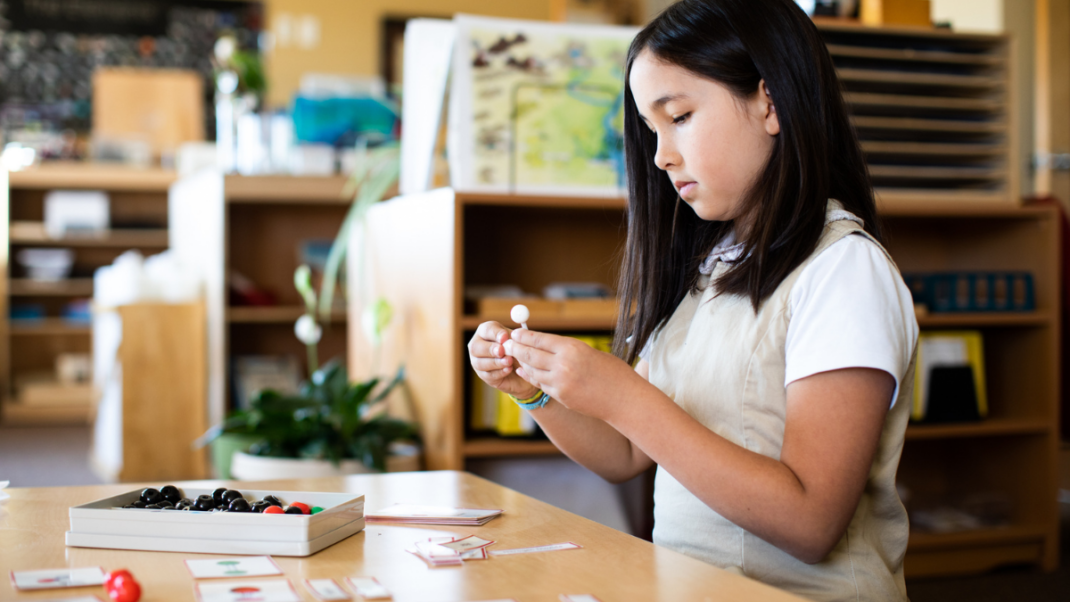
Montessori materials are not simply pretty wooden toys. Each one is carefully designed to isolate a single concept, whether weight, color, sound, or letter formation, so children can work through it independently and at their own pace. The materials span five areas: practical life, sensorial, math, language, and cultural subjects.
They should be complete, clean, in good condition, and accessible on open shelves at the child’s height. In our classrooms, you’ll find a wide range of learning materials and tools designed for hands-on exploration. An authentic Montessori Daycare or school prioritizes natural, minimalist materials to reduce overstimulation and promote deep concentration.
4. Child-Directed Work Choices
In a genuine Montessori classroom, children choose their own work within a prepared structure. Your child might spend an entire morning deeply engaged with one activity. That is not a lack of direction. That is concentration developing in real time. Look for children who appear purposeful and calm, moving independently through the room with clear intention.
5. The Uninterrupted Work Cycle of 2 to 3 Hours
This is one of the most important and most commonly cut features of authentic Montessori. Children need a long, unbroken block of time each morning to settle into deep, focused work. Frequent transitions, group interruptions, or short rotations undermine this completely.
Ask directly: How long is your morning work cycle, and what interrupts it? The answer will tell you a lot.
What the Classroom Environment Should Feel Like
You will know you are in a well-prepared Montessori environment fairly quickly. It should feel calm, organized, and purposeful. Here is what to look for:
- Child-sized furniture, including tables, chairs, and shelves all at a child’s height
- Open, accessible shelves stocked with materials children can reach and return on their own
- Natural light and natural materials including wood, fabric, and glass
- Plants and sometimes small animals as part of practical life care routines
- No teacher desk dominating the room. The Guide moves through the space rather than standing at the front
- A quiet, purposeful hum of activity rather than noise or enforced silence
If a classroom feels chaotic and loud, or sterile and overly controlled, either extreme is worth paying attention to.
Frequently Asked Questions About Montessori in [City]
These are the questions families ask most often when evaluating Montessori programs. We have answered them here so you can come to a tour already informed.
What is the difference between an AMS school, an AMI school, and a school that just calls itself Montessori?
AMS and AMI are the two major accrediting bodies for Montessori programs. Schools that earn accreditation from either organization have been reviewed against a detailed set of standards covering environment, teacher training, and program fidelity. A school that simply uses the Montessori name has made no such commitment. When touring any program, ask whether they hold or are pursuing AMS or AMI accreditation, and how they ensure their program stays true to Montessori principles over time.
Does my child’s teacher need to be Montessori certified?
Montessori credentials from AMS, AMI, or MACTE programs indicate a teacher has received specialized training in child development and Montessori methodology. That training matters. But it is also worth asking about a school’s approach to ongoing professional development, mentorship, and support for teachers at different stages of their Montessori journey. A school that invests in its teachers consistently is often more reliable than one that hired one credentialed teacher and stopped there.
What ages does Montessori work best for?
Montessori is designed for children from birth through adolescence, with distinct environments for each developmental stage. The early childhood program, typically ages 3 through 6, is the most widely available. This is considered one of the most impactful stages because it aligns with what Montessori called sensitive periods: windows of time when children are especially receptive to language, movement, order, and sensory learning.
How do I know if my child will thrive in a Montessori environment?
Most young children adapt well to Montessori environments, especially when the program is implemented with consistency and warmth. Children who enjoy exploring at their own pace, who are curious and hands-on, and who benefit from calm and order often take to it quickly. That said, the quality of the program and the relationship your child builds with their Guide matter more than any checklist. Your child will feel inspired to learn in a self-directed approach guided by our teachers. We are here to support you as you prepare your child for Montessori Preschool in [Location], ensuring an environment where they are free to explore their natural interests.
Come See It for Yourself
Touring a school is the best way to understand whether it truly lives out these principles. The environment should feel calm and purposeful, the Guides should be able to speak clearly about why things are set up the way they are, and your child should walk in and feel a quiet pull toward the work waiting for them.
Families in [City] choose [School Name] because they see the difference a prepared environment and a trusted Guide make in their child’s confidence and independence. We would love to show you what that looks like in person. Schedule a tour today.
Related Posts
All Posts
Montessori in {{City, State}}: How to Choose an Authentic Montessori Program for Your Child at {{SchoolName}}

Montessori in {City, State}: A Parent’s Guide to Independence and Discovery at {SchoolName}